lundi 1 mai 2017

Townshend Allegri preamplifier


It is a strange animal. It is small. It is very light. It does not have a plug at its back since it is passive. When you are used to big preampli like I am used to, it is strange to handle it and to connect your cables to it.
Let's start with the minus sides.
Knobs feeling is cheap. Movement and feeling is like on a Rega Integrated amplifier. The rca connectors are on the same level. Cheap. If you have special cables be aware you could be not able to connect them to its back since the tight space between the rca connectors.
You also have a strong crosstalk. If you are listening to a cd in the 1 positioin when you go to position 2 you will able to ear it very attenuated but you will ear it anyway.
The mute switch is very useful, at least for me, but it is brutal, it is like you unplug a cable, you have a tack sound in your loudspeakers.
It is extremely sensitive to cables.
Volume control may not allow you to find the attenuation you want, but if you know the values you need Townshend will build one to meet your specifications.

The down sides are many so what about the plus sides?
The Allegri, in absolute term, when used with the right cables, is a stunning device.
Stunnning not in relation to its price but stunning in relation to any price.
The first thing you notice is that it is alive. It is not like a normal passive preamp that tends to suck the power out of the music message. It is not like an active one with an heavy hand on the musical message either. It is agile, but not light, it is fast but not aggressive. And it times very well and for me this is essential. Too many products, while seductive in their music proposition are dead or almost dead in timing regards. They don't swing. They have a kind of dead hand on the sound. 
Preamplifier are strange beasts. I have heard and owned in my hifi life so many and so many I didn't like it is embarassing. They always have something that is better not having. I don't know why; and worst of all when I had found one or two that I liked after a while they were so predictible that the listening became ridiculous. The kind: " ok now there is a piano and forget about it,it  is going to be like a waterfal of notes or perfect now you have the percussion and I am going to hear the drum skin but then unfortunately the singer is going to sing soon after. Or something like: "wow I can hear every insignificant details, every breaths, the colour of the wall paper and the sigarette maker of what Tom Waits is smoking but why I don't hear more about the music, about the timbres, about the musical expression?" Yes, very frustrating. I have found at the end few preamplifiers that I still have but their price is embarassing. At the end I have a summary result of my experience, maybe wrongly but this is what I have in my heart: entry level preamplifier are ok because you need them like you need to put oil in your car; mid level are better but at the same tiime a waste of money since you cannot be satisfied with any of them. Hi end... some are useless, some are just ok, very few are good.
What I am comparing the Allegri to are to the few that are good.
But how come? It is not the Allegri a mid level price product? Yes it is, but it is a passive unit. But it is really the Allegri that good that can be compared to preamplifier costing at least three times more? Yes it is that good. And it is the Allegri that good that can be compared to the best out there regardless of the price? Yes it is that good. So why, if I can spend any kind of money I should buy the mega expensive good ones?  It is a good question and a fascinating result in my personal listening. When you analize the sound of the Allegri in comparison to my two references they are not passive like the Allegri is, the Allegri is more or less on their level. Frequency extension, bass articulation, focalisaton, organic presentation, capacity of distinquishing reverberations and note attack and decays and so on.
And of course the ability to make music alive. My references have something more though. The first thing they have is a misterious one: they let you hear the musician intention. 
I don't want to put in words this since it can be long but when you ear it is clear.
For example you listen for the million time Bob Marley singing Jamming and you don't ear only the nice simple song but you are also made aware of same frases  Marley clearly sings with a mystic attitude like for few seconds he is praying with is heart while singing.
The second one is: the music is more... anchored? This is also very strange. I could make this example: it is like with the Allegri the iinstruments are subject to a lesser gravity strength. With my references I hear the music and instruments and sounds and silences and so on like belonging to the space and time I am at the same time I listen. The Allegri is not in the same planet where I am, where my reality is. It is in a similar planet, a planet that has a little less gravity force like Venus.  The sounds are not ligther with the Allegri for they miss some timbric shading or some frequency extension . It is more like the effect is due to the nature from which the sound comes out that we are talking about. I don't know how to put this in better words and expecially I am wondering from what this effect can come out. But for my ears it doesn't matter. This is what I ear. It is reminescent of the difference between a electrostatic speaker in comparison to a coned one.
One thing to notice. It is very cable sensitive. You can kill it with a wrong cable. So if you decide to buy it have few cables on hand.
One suggestion: it works well with cables that have a simple construction geometry and that are alive sounding. It goes very well with VDH The Integration if you don't want spend too much, and it matches to it much better then cables costiing 5 times more, or if you streach a little more from the same mother company you can get a Fractal. Be careful, it is not a question of wanting spending a fortune on cables, it likes the right one and fortunally the right ones are not terrible expensives.

dimanche 19 février 2017

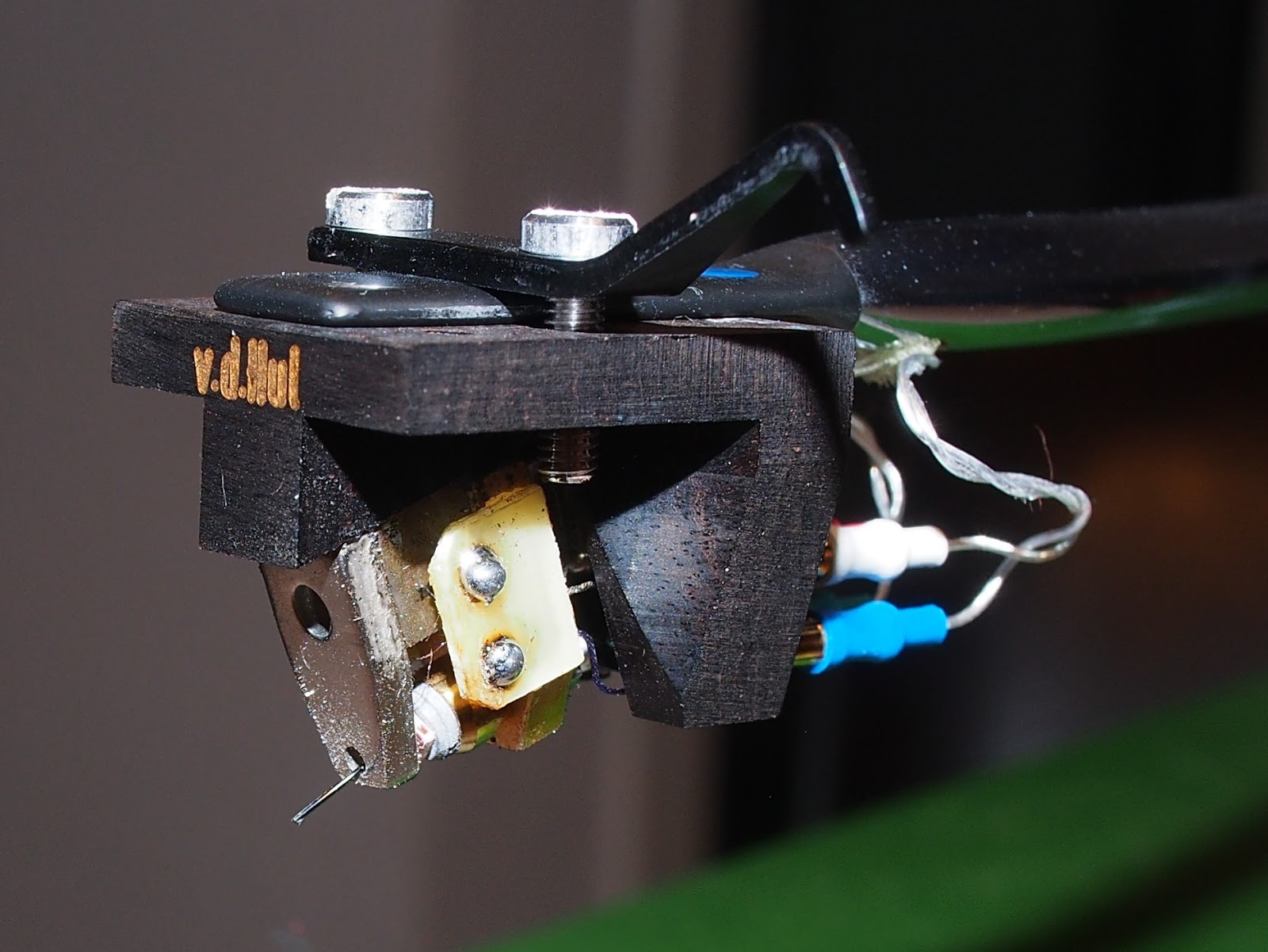
VDH The Crimson Hard Wood Stradivarius (and comparison with VDH SE Ebony)


OK now is getting a lot of work with this special VDH cartridges. It is fun since this high end cartridges all sound extremely well, so it is really useless to say one is really better the other one.
This is another special top from VDH. Is the special edition hard wood stradivarius.
I have listened to the Stradivarius (not hard wood) and to the Special edition (ebony) and of both I have written here in my blog.
They are called stradivarius since these models use on their woods a laquer similar to the one Stradivari used for his violins. The difference between the Special edition Ebony and this one is the use of a different wood. The body  of this one as mentioned is made of an hard wood.
But something is deeply wrong. Let’s put it clear ; Stradivari would have never laqued one of his violins like this. The body of the cartridge is laqued in a very it is good when it is finished manner. Brutal brushed and not uniform. Some dust traces trapped in the laquer too… Maybe because I am Italian and even though I have not lived in Italy for the last 25 years, I have kept a certain sensibilitiy for the estetics but when I reed Stradivarius I expect a little Stradivari attitude not just a laquer spit. In a great workmanship you never have something that looks hurried up or when it is finished is better. No. Everything comes from the love of beauty. The beauty of the product that is going to be finished to be used. This field of using it covers also the use of our eyes. Of course! Our eyes use the product too. They are part of our senses.
So Stradivarius… no, I don’t accept this name. Sorry. I feel even bad about it using this name.
But does it sound like a Stradivarius? Now the fun its mine trying to write about it.
The very strange thing is that in a comparison between the Special Edition (ebony) and this one hard wood Stradivarius the lates one really sounds more like a stradivarius!
When I was much younger I had the great opportunity to be able to ear in Cremona (where the great luters where having fun ) a violist that played three different violins to make people ear the differences of their sound. The player was the same so it was not the differences in which each violin was played that made the differences in their sound. The Guarnieri sounded projected, but dense, powerful. When he played a Stradivari (I don't remember the name of this violin) the sound was more clear, like a light was coming out of it, the sound seamed to come out of it in an easier way with more shadings in its timbres expecially in the higher tone that had a very unique characteristique to be at the same time extremely clear but with a certain sweatness guiven by a special fluidity. It had less propulsion then the Guarnieri but more radiation, with this meaning that I had the impression of the sound coming from a radiationg source and with the Guarnieri from a more directional one. With the Stradivari it was like the player and the violin disappeared in a certain way or the violin swallowed the player I don't know or the player got lost in the violin? you maybe had the idea. There was less struggle in the symbiosis between the player and the instrument but part of this struggle is also nice to ear. It was beautiful to ear it coming from the Guarnieri. The player was there, the violin too and the music too. With the Stradivari there was only the music.
Or maybe the light coming out of it made the three components melding in each other. A very interesting point was that the player of this performancebefore playing said the violins sounds would be more clear to us the listeners that to himself the player. He said he could detect more the difference in the playing tactile feelings.
I could talk also of the sound of the third violins that he played that was an Amati, but for the reason of this cartridge test i will stay with the difference between a Guarnieri and a Stradivari.
Ths VDH hard wood stradivari cartridge has the kind of easines of music coming out of it with a light touch but at the same time with a certain power that the Stradivari violin has. It is clear but not cold, it is articlulated but not tight, it is transparent to the sound but never harsh. Expecially it can play everything with style. Baroque or Lou Reed singing Heroin in Rock and Roll Animal it is the same for this cartridge. It gets the right emotions out of them. The hard wood Stradivari is a soul scanner. It gets out the soul of the music it is playing. It gets concentrated to the music to the heart ofthe music. It is able to do so also because it gets out of the message things that don't belong to the music, so mechanical noises and noise floor are very very low for a cartridge. Silences are deep and made of a different density then from the other part of the reproduction and this is how it should be. Silence does not get dirty with frequencies, frequencies expande in the nature of the silence.
And then this cartridge is fast. It is very fast, but fast and agile so it is more like light weight boxer.
It could be of interest to compare the sound of this hard wood Stradivarius to the Special Edition (Ebony). Both are great cartridges but they are different. The HD Stradivarius is surely more elegant, more agile, and has more colours. The Ebony has more power, but not in absolute term. It has a more concentrated power.It is more dense in its expression of the musical energy. It is more there. The Ebony is more a Guarnieri. Maybe VDH should call the Special Edition Ebony Guarnieri? In the future he could make also an Amati... VDH The Crimson Stradivarius, VDH The Crimson Guarnieri, VDH The Crimson Amati why not!
The Stradivari as I said gets the soul of the music coming out, the Ebony the energy, the substance, the life as a more simple movement then the soul.
They are both neutral in caracter. Not warm sounding not cold sounding. The Hard Wood Stradivarius is a cool spring day, the Ebony is a cool autumn day. So the temperature is the same, let's say 16 degree but things are different.
Both are a beautiful situation to have the walk of your life. In a cool spring day there are more distincts smells, more differents colours. In a warm autumn day there are still many colours, but they tend to shade to something common. The VDH SE Ebony is like this autumn day in comparison to the SE HD Stradivarius. This last one is  more transparent is more big sounding but not more musical.
So at the end I thing the HD Stradivarius is in absolute term a better cartridge and when changing from the Ebony to the Stradivarius you are made aware of it. But after a while you remember the Ebony, its coherence and its completely unmechanical sounding way. The Ebony has a global coherence that the Stradivarius does not have. Timing, timbres and speed and attack and decays and everything else that makes the music a whole it seems coming from the same block, from the same window. The Stradivarius has more windows. It have more dynamic freedom, it is more open and big sounding. I always liked The Wall from Pink Floyd but I have never loved it. The Stradivarius playing The Wall lives you in a real total disbelieve. The Ebony not.  In complex music the Stradivarius has something really special going on. It sorts out complexity in a simple way like a Stradivarius violin would play it, with ease. In simple things you feel it would like to do something more like a predator waiting for that jump he does not have the occasion to do. The Ebony does not leave you in disbelieve neither gives you the feeling it waits something special to express itself at its best. Also in its global performance is more coherent, more on the same level whatever it is playing. You get attached to the Ebony like to a Guarnieri. I have always loved Guarnieri. But a Stradivari ,how beautiful can it sounds!
My only regreat is not having right now enough money to buy any of the two.
Actually I would like to buy both.

dimanche 12 février 2017

Oil test for LP12


The black oil is the best for the most recent LP12, other oil can do harm on the bearing and so on. How many times we have been reading these things but we strongly feel between the lines that such affirmations come out from an ideology more then from a real test. It is true I have never seen testin oil for the LP12 but a lot of discussion about it.
So I gave them a try. Like many of you using the LP12 I have been using the standard black oil without going deep to the soninc problem of the oil itself. But now that I have tried I can tell you : the nature of oil have a marked effect on the sound of your LP12! This was to be expected since it changes in a way or another the nature of the friction of the main bearing.

I have tried for this comparative the standard Linn black oil the VDH special turntable spindle oil and the VDH TLFII.

Changing from the Linn black to the VDH special spindle the difference was very marked. The high frequencies were highlighted but not in an aggressive way, the bass got very tight and the propulsion of the music grew up, yes it was pushing. The sound got closer to a Xerxes. What was lost in this clean as a wistle sound was a certain feeling of relaxation and working on timbric differentiations.

Putting the black oil back and things got back to where I was used to. Lost was the pushing force of the VDH special spindle oil but music got more organic in its presentation. 
The VDH special spindle oil is made for not very tight tollerance bearings so maybe the LP12 has a too tight tollerance for this kind of oil? Or the resulting sound is equivalent to a sound with a tighter tollerance bearing? I don't know, I just tell you about the sound it comes out of it.

Then I have changed the black oil for the VDH TLFII. 
Now things got interesting. The differences were less marked then passing from the black oil to the VDH special spindle oil; the caracter of the sound kepts its basic nature but music was really flowing better. This is very strange to expain but it was very obvious. In comparison to the Linn black oil the timbres were better differentiated without for this reason having any shift in the tonality spectrum. This was expecially evident in the reproduction of the nylon guitar strings and also in violins. Voices had just a slight more inflection in their expressivness and a slight more relaxed expression. But things were globally better.
Another extremely strange thing was that the sound got more constant. In a same LP if with the black oil there were songs that you were wondering they had been recorded in a worse way than others, with the TLFII this did not happen. I think this is because the timbre of the instruments were more complete and with this there is a wider margin of musical satisfaction even when things are less then perfect. It is like having a little bit more money. You have more margin to get to zero.

Another thing is that using the VDH TLFII I could reduce the loading of my used cartridge. If with the black oil I had felt the best loading for a certain cartridge was for example 500ohm, using the VDH TLFII I could go to 1000. It is not that 500 was not working any more, I wrote my findings using the same load for each oil,  it is just I could load less without loosing the coherence of the sound. And being able to loading less without sonic negatives can give you some advantages if not the one to be able to choose without punishment.

I think, and I could be probably wrong, that we need to load a cartridge also to compensate the vibrations coming from the rest of the playback system.

So the VDH TLFII will be the oil for my LP12. With no Tiger Paw Tranquility.

PS: I have used also the Tiger Paw Tranquility to test these different oils thinking that since the load on the bearing with it is reduced the sound of the oil could be different. And so it was! The VDH special spindle oil was surely the best. It showed the black Linn oil to produce a slight bluring on the medium bass frequencies. Dynamic contrast was better, sound was tighter but not contracted, it got closer to a Naim standard. Tight and more deep bass, hi frequencies very well contained in their harmonics structure, and more dense. Expecially the timing character was more complex, less simplified. It was more evident the contrast between the melodic flowing and the rithmic pulse. I could be able to reduce the loading of the cartridge (even get to 47Kohm!) with no adverse effect like I could do using the VDH TLFII without the Tranquility.
The VDH TLFII with the Tranquility was almost on the same level then the black Linn one. A touch too free flowing a la Luxman 70s. Loosing a little grip that the Linn oil had and that the VDH special spindle had to even a greater degree.

VDH Special spindle oil will be my oil with my Linn LP12 fitted with a Tiger Paw Tranquility.

samedi 4 février 2017

Tiger Paw Tranquility (for Linn LP12) or a stroke of genius


Before this it was the circus upgrade. It was the circus that lowered the noise floor of the LP12 and brought it to a more modern sound. 
It is true that what people like about the pre-circus sound is understandable with the right attitude. It has a special music flow. It is nice . But it is nice in the same way an impressionist painting is nice. The lines are blurred in the surrounding space, in a structure where the division between the objects is less pronounced in favour of their inner communion with the totality. It is nice but it is not real. 
If you,  like me, are after a more realistic reproduction of the music and you have already invested a lot of money for it you cannot go after alteration but after accuracy. Maybe, and I say maybe you will fiter out bad alterations trying to keep the ones you like or that you can more easily live with. The ones that gives you what is inevitably lost during reproduction and that the most perfect transparent device cannot give you back since it is  lost. 
One day, years after the circus, It cames the Keel, a beautiful upgrade, but at a beautiful price. Another day was the turn of the Radikal, belonging to the category don’t try if you are not in the positiion of buying it if not you will suffer, very effective but also effective to have a lot less money in your bank account. So what about less expensive upgrades? Why you have to spend all of this money? The reason is simple. To spend less money you need a simple thought of simple esecution to keep cost down. And to do this you need a smart idea. A Stroke of genious: the Tranquility. A magnetic gravitational help for the LP12 platter. It is composed by two opposing magnets that repulsing each other take away some weight from the platter so it will have the same rotational mass, but less weight on the bearing. 

What it brings to the sonic picture  was easy to appreciate. Not need to put the sonar mode on your ears. The installation is quite intuitive with only one thing to be really carefull about; I will develop this last thing later.
Once mounted it is very easy to realize the sound coming from your LP12 opened up. The dynamic window streachs out in an evident way. Sound is bigger. You are immersed in the same space of the music your hifi is playing. But expecially the noise floor is absolutely lowered.
The space surrounding the instruments changes its nature. It is not of the same timbric colour of the instuments. To say it better: the instuments decay don't make the space, but the space is a real diffent entity of a different nature, dark, in which instruments extists. Without the Tranquility the space is more "noisy" is less silent in colour, it contains a certain haze and the contrast in which the instruments play of course is less evident.
But it is not just the silence of the space that is changed; also the instruments are different. 

                                     
As a consequence of this silence they are more individualized, but since the noise floor is lower their timbre is more realistic.
It is like going from a $50 cable to a $1500 one. And maybe more. It is like going from a Dynavector 17 MKIII to a XV1S.
I have tried it in three different LP12 with different arms and set up. In my very first day of listening to it I have thought that everything was better but that something was missing : a certain natural flow of the music and a slight propulsion. Almost the same thing few people say about the circus upgrade. After few days I have got back this missing natural flow. How? I have found that for this is very important the distance between the two magnets. The magnet that is to be installed on the suspended chassis has a possibility to be adjusted in its hight. You just turn it either down or up to do it. To have the best result you have to adjust it this way: put the platter with its Tranquility magnet on the subchassis magnet and when you turn the platter do it in a way that the too magnets get in friction so that they will touch each other. To do it you have to give the subchassis magnet a certain height. It is very easy to ear it. Just turn the platter and you will ear it. Then you fix the hight of the lower magnet turning it down just to the exact point when it does not touch the upper one any more; that's it. It will take 10 minutes to do it.

Earing the difference the Tranquility brings to the sound is a very easy thing to appreciate, and it is a difference of a big improvement not just a different taste.


To sum it up: with no doubt  the best LP12 upgrade for the money ever made and by far.
Great stuff!


jeudi 26 janvier 2017

Rockna Audio Wavedream DAC


This Dac belongs to the expensive ones, in Europe it costs 50 euro short of 6000 (the basic version), so what can we say from opening the box?
The box in which it is shipped in does not seam really adapted and you have the bad impression the thing has been put inside quickly and with no care. Fortunately the unit is inside a cloth bag to confirm it is a little expensive.
The remote control: from the outside it is packed in a plastic thing that looks has been used for few years even though is unopened, so they used an old plastic to seal the remote in. The remote itself has a sign of shock that cannot received during the transportation, so it has been put inside with no care or who put it saw  put it in the box nevertheless, or nobody checked it...and it has sign of wearing even though it looks at the same time new. It looks like the bottoms are new but the base where the batteries go is somehow not new. Strange and not good to see.
And the best for last. The remote controle has a GoldeNote logo in its central bottom. Rockna just added its name with a small decal at the bottom of it! It is like let's search for a remote that is out there and we put a logo to say that now is ours! At least replace-erase  the central GoldeNote logo or just change it I don't know, but all this look like: we don't care as long as it works.
I wanted to start from this point before even listening to it because I think it is essential that for this kind of money you should have some care for things that are not really dettails...
Even though this unit could sound extremely well, these things are not acceptable. It is not possible to say everything you pay has been put in its performance; it would be like saying you go in a very expensive restaurant where the food is very good but the service is terrible and the tables are dirties. I think it is a question of respect. And then as a valid excuse they tell you: you have paid to eat here not to look around! No way! It gives the impression that these things I am talking about are not even taken in consideration. Very bad point in my opinion.

The building of the unit itself is good considering the not large number of production. It is half way from industrial and artigianal. In the internet I have seen previous Wavedream units (I have received this one new today so I guess it is one of the latest) with a nicer engraved logo. The new one has some aeration holes but the design is not so nice as before; but I don't care much about it. Or it could be that the more expensive models (this is the basic single ended unit) have the better looking engraved logo. This I cannot say.
The bottoms of the front face have a normal feeling, not smooth good but not chuncky bad; between the two.

A good point is the unit weight. It gives you somehow a sense of solidity. At least this. But strangely at the end you have a mixed feeling of solidity and not solidity at the same time. For example a Naim DAC that is much less expensive gives you a much better feeling of solidity, and it is better made and it has a much better packing and it is not made in Japan, so it is possible to do much better for the Rockna Wavedream price.

Powering the unit up the display has a colour that I didn't find that attractive (dark yellow) but this is just personal taste. It does its job extremely well though. It is very well visible even from distance and even at low brightness: good point! The first good point!

Now the unit is playing and I will give it a critical listening in 4 days of continuous playing.

In the meantime the unit is cooking I would like to say what I think about separate dacs. Generally I tend to prefer single drive unit. Even though with a separate dac you surely improve some parameters like transparency, timbres accuracy, image, generally the global musicality looses something essential, the rithmic drive is generally less well expressed. In few words in the last 20 years what I can say about separate dacs is that they propose you a more intellectualized version of the music.

Another thing is that with separate dacs generally, and maybe for the formentioned reasons, the listenability of what you play becomes more critical. Cheap pop things don't sound well. With good separate dacs generally you end up listening to less records.

I love wood instruments, the vibration of their body and resonance; and I love piano. It is sharp, it can be powerful or delicate, it can go for tink for TOONG, and it is extremely difficult to reproduce for an hifi.
So I started with Soundgarden as a cooking music. But Soundgarden don't play piano neither wood instruments! So what, I have a very large music taste. This recording made me realize, without even paying attention to it and even though it was playing at low level the very first thing about this DAC: this music sound strangely ok. More it sound quite good!
You know what I mean with this statment. You can listen to pop music in your small sistem or stereo but as soon as you play it in your hi-end one that's it. It is finished. It doesn't sound like music any more. It is hard, it looses coherence, it is aggressive. Many years of explication of bad recording dindn't convince me at all about it. It is not about the recording! It is about the reproducing system. Often to get more dynamic, more definition more this and more that to justify the price you have paid, the hi end stuff loose the meaning of the music. In search of the perfection it looses the soul, the cpoherence the whole thing. If this sound could be compared with an image it would look like the beautiful lady that to be more beautiful had some esthetic surgery and you know the result... the nose is better in its lines, the mouth is bigger and more pronounced the skin is tighter but at the end the global result is extremely...let's say extremely strange. Surely not good.
So if you have a very expensive hifi and you cannot play all the music that you like, your system has a problem. Something is not even. everything that compose the reproduction of music are not balanced in a good manner. If for example you have much better definition of instruments but the fullnes and richness of the timbres does not follow it, it can easily sound edgy. So you cannot boost one aspect at the expense of another one without paying for this at the end. Be reassured most of hifi hiend system suffer from this disease.
So when the music was playing at low volume level and was  that kind of music that sound generally bad in big system but iin this case was sounding quite good I had a thought: this DAC cannot be bad.


So now I am ready to tell you how it sounds.
First of all it is good to say that this DAC has a volume control and if it is going to be your only source you have to be reassured that this volume control is of extremely high quality.
Extremely high it means that if you connect it directly to a power amplifier to have something better you have to spend a lot. A lot means more then 12.000 euro. On all the other cases the dynamic window is going to be restrained and the transparency compromise and the timing too.
Another thing is that you re going to be able to change some parameters as filters and so on.
The good thing is that if you have a small system this parameters are going to make small changes, if you have an hi end system well assembled (very rare) they make a clear difference. Like changing cables. So if for you changing cables does not make any difference don't even bother with it.
The bad thing is that all this setting is going to change depending if you connect this dac directly to a power amp or to a preamplifier.
So my preferred setting with a direct connection to a power amp was with filters off, stream clock and dither on. Connected to preamplifiers my preferred setting was: filter Linear, Dither On, Clock Local. So very different. 
The filter settings with direct connection to a power amps were working like compressors in a way and I have felt they all were robbing timbre realism and dynamic. So in direct connection filter was off. Remember that I am talking about the direct connections to amps of which the less expensive one was costings 10.000 euros...
Filter setting seamed to change other electrical parameters of interface with the preamp. Maybe the impedence? I have to investigate about it or maybe not. At the end who cares. At least I don't care. Not so if the dac was connected to preamplifers. In this case the filter were more felt in a way of more or less enphasy on the high frequency and expecially how the extreme frequencies were integrating to the lower ones. 
With lesser preampli-amp and speakers combo filters are useful to control aggressivness. And something more. Sometimes for example, depending on the preamp, using a filter you can enhance the separation from direct sounds and reverberations.

So you have to understand that if you have a very hi end system you have to play a little to find your optimal setting with this dac to get the best out of it. For example with a Townshend Allegri a have found that the Hybrid filter with Dither on and Clock Local was working the best, with an Audio Research Reference 6 (thank you to a friend of mine for let me trying this preamplifier) I have found the best setting to be filter Minimun, Dither on, Clock Stream.
So how does it sound when it is set up to your liking and to be matched to your system?
The answer is extremely simple: this is a mother fxxx of dac! And for the first time a separate dac has in itself the virtues of a single player organic timing and the trasparency of a separate unit. This single virtue for me it is the most impmortant one. Who cares about transparency, bass, medium and hi frequencies if somehow this don't give you an organic result? Up to the Rockna no separate unit has been capable to convince me on this last parameter.
The nice thing is that the Rockna keeps the nice things you get with separate DACs so you get more transparency, better separations, and better timbres.
A very welcome and unexpected quality is the presence. With this I mean that the tones are deep. You get the feeling of a certain kind of materialisation. This kind of materialisation is not at the expenses as usually happens of a light touch. You know what I mean: things get thick and you have a feeling of soffocation. No, it manage to keep things light at the same time and free. It is very, very slightly dark in tonality.
It plays all kind of music in a very interesting way, from rock to baroque, giving a beautiful mixture of detail, timing, and expression expecially in the mid-range, so voices are perfectly reproduced with their inflections and body. The low region is well timed and deep, articulated but not dry tight, a good compromise to never give you the feeling of overdoing or paying attention to it. mid high are reproduced in the best possible way, and this is a very critical region. The high frequencies are very, very clear without never sounding aggressive. Maybe I would have liked a little more bite at the expensense of sometimes getting hurt, but then if that would have happened maybe I would have critized it! Expecially no disc sound bad or is too bad recorded to be played! there is always something good about it if not technically at least musically.
By large my favorite separate DAC ever and with no doubt among the best three DACs in the market. I didn't say four but three! It can be connected to many things, go and discover it, I only write about its musical capabilities.


PS: in the meantime I have received, not myself but a Rockna distributor, an email clarifying few points:

for the logo: all dacs/transports will from now on have this same logo.

for the remote control: the units that will be shipped from now will have a much better, full metal remote.

for the packaging: we are in contact with a new supplier for better quality; starting from March we'll have improved packing solution.

vendredi 18 novembre 2016

Van den Hul The Crimson Special Edition (Ebony)


I really liked the Crimson as you can read in an older article of mine.
So I was somehow curious about this version. In which parameter this SE would be a better Crimson ? At the same time I thought it would have been a difficult task since the Crimson is an extremely well balanced cartridge and most of the time with very well balanced product when you try to make them better you improve few characteristics but you loose some others. In a way this is what happens with the SE version, but it is not the all story. I would say that the Crimson SE does not sound as a Crimson. The difference between a Crimson and a Crimson SE is at least as marked as the difference between a Dynavector XV1S and a Koetsu Rosewood. VDH could have very easily called this cartridge with a different name. The only thing is that estetically they would be too close for a customer to accept a different name. The only thing I can notice is the wood body in the SE version made from ebony.
The difference between the SE and the standard Crimson reminded me of the difference between two cartridge that I love but that are not in production any more : the Myabi Standard and the Myabi 47.
But in this case the VDH Crimson SE would be the Myabe Standard and the VDH Crimson the Myabi 47.
The SE is so different from the normal Crimson that it is not that if you like one you would like the other one too. Actually it is not too difficult to like both since both are exceptional cartridges but they excerse their virtues in different territories.

In a not comparative test The Crimson would be appreciated for its timbric shades expecially in the medium range, and the rare capability to sound fast but delicate at the same time. It sounds more like an electrostatic speaker.
The VDH SE would be loved for its dynamic swing, it has a very high dynamic contrast and it is tight and the instruments are really carved out. Its shades are more presents in the differentiation of the attack of the notes. If Naim would have ever made a cartridge this would be it.

In direct comparison their differences are even more pronounced. First of all we are aware of a different tonal equilibre. The medium of the SE is more recessed and darker and timbrically simplified but not the medium high. The image landscape is different too: the SE is more upfront but the layering in the depth field is more evident. This layering is highlighted from a much more pronounced dynamic contrast of the different instruments. The decay of the notes are shorter with the SE but have more energy and this partecipate to make the instruments more carved out and the space between the instruments more silent. Since the attack of each instruments is more evident with the SE there is also a feeling of more urgence and more energy in the medium- high, high frequencies range that are beautifully rendered. This region is portraied with exceptional realism since you don't have here preserved just the energy but also the timbrical richness and density and this is extremely rare if not unique. In comparison the Crimson is less compact and solid in this same frequencies, more light. The overall sound of the SE is tight and going toward the dry side. I use this adjective not as a bad thing since a wood instrument sounds better when is dry. Strings sound better too, percussions sound better too, piano sound better too, cymbals too, the human voice sounds... it sounds better on the normal Crimson. In the normal Crimson the human voice has a more complex painting. Timbres working of the voice and its inflection are much more evident. In the SE the human voice is in comparison more simplified.

Where the Crimson is delicate, the SE is firm and tight; where the Crimson let it go, the SE get in control of things; where the Crismson paint with 20 colours the SE uses 15; where the Crimson let you see the shading graduations between two different graduations of dynamics and timbres, the SE make you much see much better there are two different graduations in their external structure. The SE differenciates the structure, the Crimson differenciate the content.

The SE is the perfect cartridge for who cares about the fondamentals of the music, for its roots, for the one that likes to be exiceted by the music. The normal Crimson is more for who listen into the music, for the one who likes to fall inside the message of the music.
If I would be pressed to compare this two cartridges to some classic hifi speaker I would say that the normal Crimson is more an electrostatic Quad while the SE is a classic Tannoy.

It is strange what this SE made me think about: my first serious amplifier: a Naim Nait 1 ( yes I am 50 years old). It has that kind of simple and at the same time effective way of comunicating the musical message. Of course it is not an entry level product so it has much more resolving power then the Nait and the astonishing density of the high frequency is something that the old Naim could only dream of as it could be only dreamed of by most of the recent or past hi-end products. But this kind of simple truth is there.
It is fast, it is reactive and agile, it is tight, it is powerful. It communicate the beauty of the energy in music. The simple truth of music.
It is a BMW Mserie, it is an Alfa Romeo Giulia Quadrifoglio, or if you are not a car lover is
for the burbon and cigarettes lovers with powerful and noisy motorcycles.
Life is beautiful if we don't make it complicated.
It is the grab and kiss not the never ending seduction game.
Not for the contemplative people.
The Crimson SE is there with the best at any price.